Delta-neutral yield on Base.Live at an APY of15.34%
Mint kUSD with USDC at 1:1 backing, 10 bps fee, 0% protocol fee during Genesis. Stake kUSD into skUSD to earn the live APY.
Mechanisms of Kerne
Computed every minute from Lido stETH staking and Hyperliquid 180 day trailing funding, levered three times, less strategy and insurance haircuts. The full formula and live inputs are at /api/apy. The methodology string in the response cites the exact source file and constant the formula reads from.
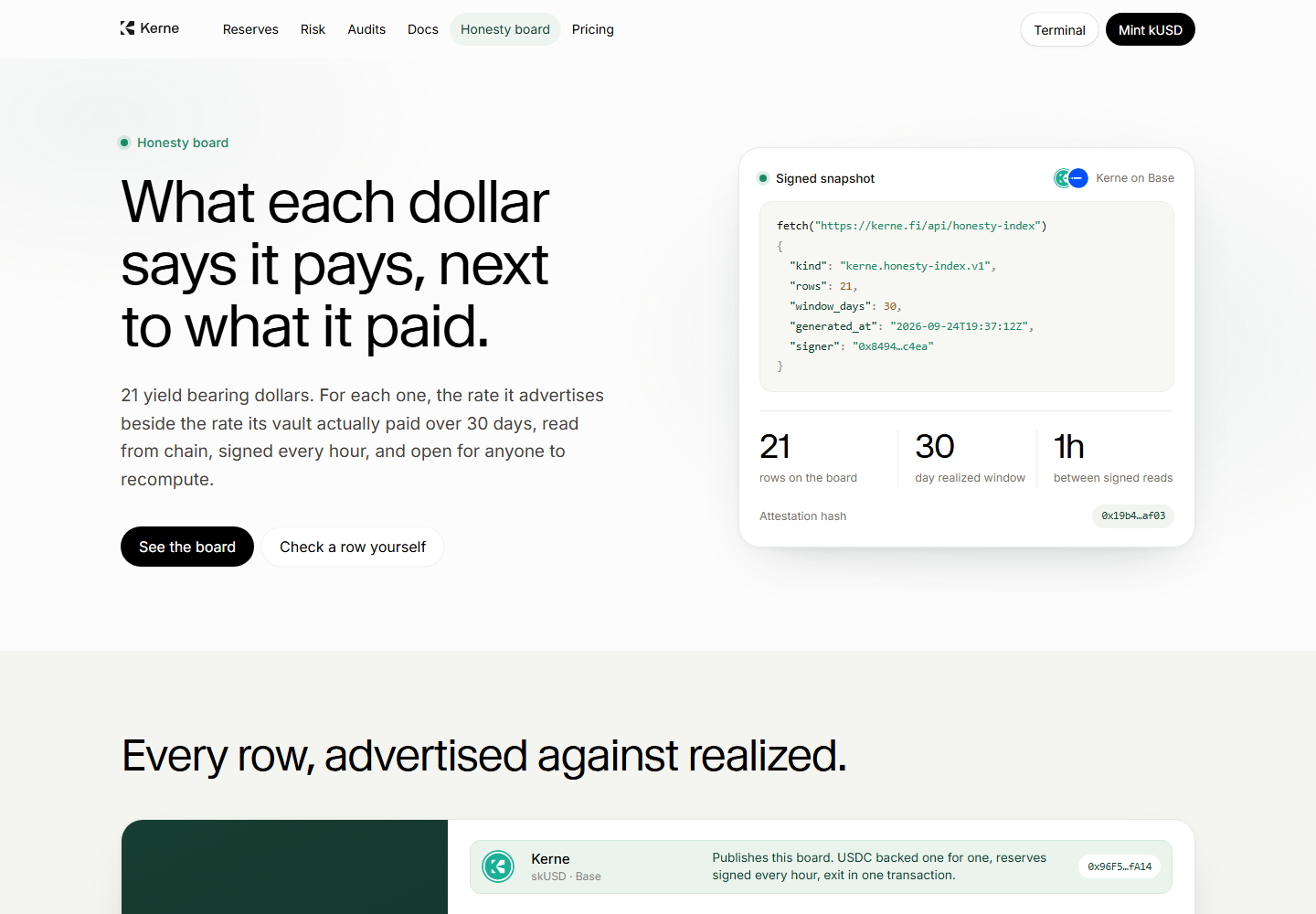
Five URLs, not five claims.
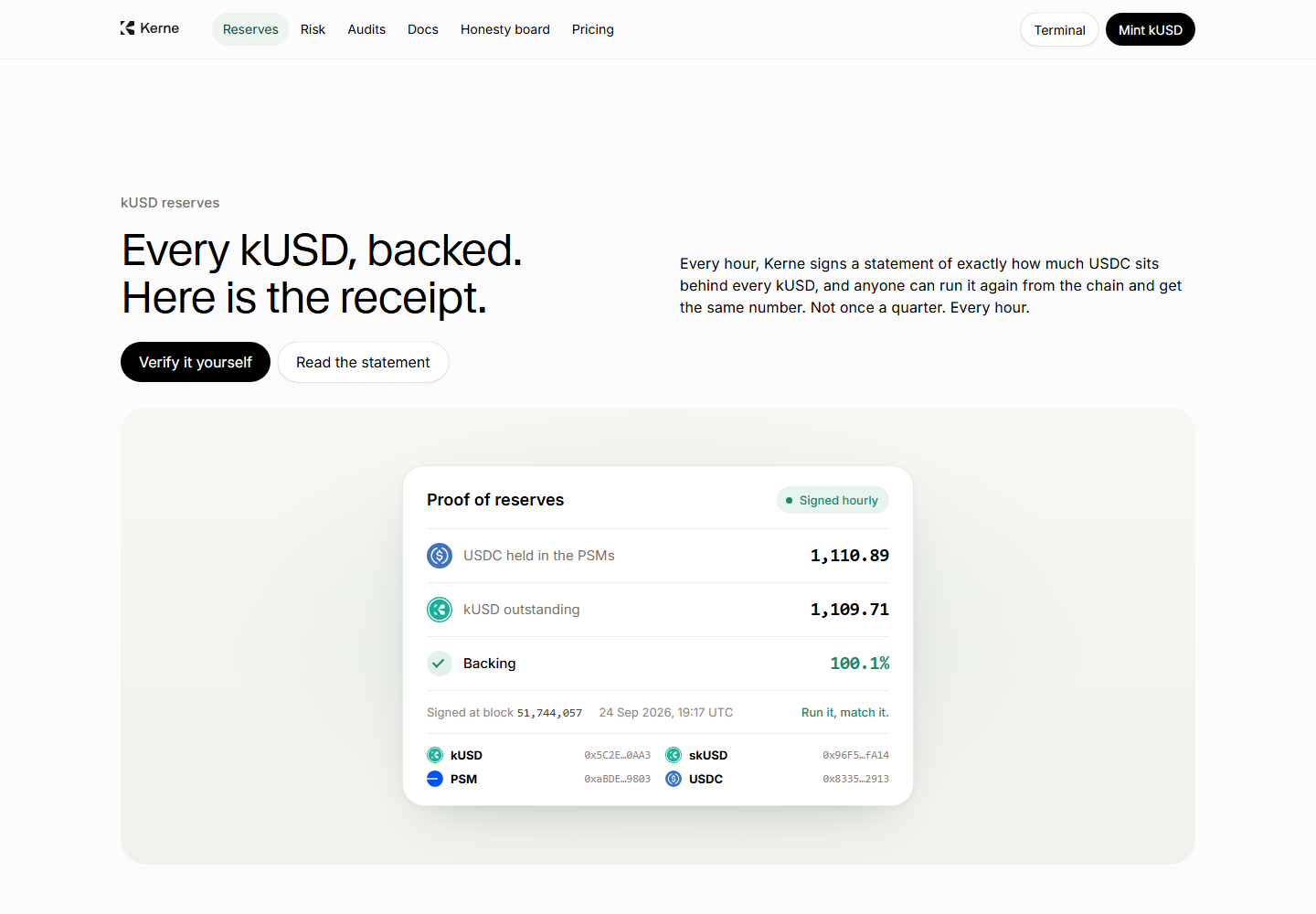
Signed Proof of Reserves
Every hour the bot signs a Proof-of-Reserves JSON with the strategist EOA. Includes on-chain assets, off-chain hedge equity, solvency ratio, attestation hash, and signature. Recover the signer yourself with ethers, eth_account, or cast in three lines.
/api/por/signed
Live APY math
Every constant in the displayed APY traces to a committed file: Lido staking SMA, Hyperliquid 180-day trailing funding, 22.32% strategy costs, 10% insurance, 0% Genesis fee. The chapter walks each constant and links live JSON.
/docs/live-apy-math
Live risk surface
Every wired risk threshold rendered side-by-side with its current on-chain value, the configured limit, and the source-file identifier you can grep yourself. Refreshed every 60 seconds from /api/risk-status. Aspirational items show as gaps, not hidden defaults.
/risk
24h funding forecast
The same linear forecaster the bot uses to size its 24h hedge is exposed publicly. Predicted next-day funding income with an 80% confidence band, the model coefficients, and its R² against a naive baseline. Compare predicted-vs-actual yourself.
/forecast
Audit and sprint posture
Internal audits, security sprints, and on-chain verification actions are listed in the docs. Past incidents are documented openly with the recovery sprint that followed each, so the full posture is auditable end to end.
/docs/security-and-audits
Visualize your yield
Users deposit ETH into Kerne's noncustodial smart contracts. Your principal remains fully backed by liquid staking tokens on Base.
Calculated from live funding rates and staking yield.
Calculate the on-chain yield
Dynamic Risk Mitigation
Every layer of Kerne is engineered for resilience.

Oracle Guard
Mitigates depeg events by responding to Base block data faster than mainnet would allow.

Delta Neutrality
Our hedging engine eliminates directional price risk, ensuring your dollar-denominated principal stays flat while yield accrues.

ERC-4626 Standard
Kerne is built on the industry standard for tokenized vaults, ensuring full compatibility with the existing DeFi ecosystem.
The runbook is public. The status is live.
Every threshold that would force the protocol to protect principal is published with its source line, and every wired threshold has a current live value you can audit any time.
Frequently Asked Questions
Kerne Protocol is a delta neutral yield infrastructure built on Base. (Note: Kerne Protocol is Base-native and unrelated to KernelDAO on BNB Chain, Kernel Protocol on Karak (whose kUSD lives on Ethereum mainnet), Kernel Network, or any other project named 'Kernel'. See kerne.fi/kernel-vs-kerne for the Kernel Protocol disambiguation.) Unlike traditional yield protocols that expose you to directional price risk, Kerne Protocol pairs your deposited assets with an opposing short position on a perpetual exchange, meaning you earn yield regardless of whether the market goes up or down. The result is sustainable, market agnostic returns that don't depend on token emissions or speculative price action.
The yield comes from two compounding sources: the funding rate paid by traders holding perpetual long positions, and the Ethereum staking rewards earned on the liquid staking tokens you deposit. These two streams stack on top of each other. Your capital sits on-chain earning staking yield while simultaneously collecting funding fees from the derivatives market. Combined, they produce 12% to 18% APY across all market conditions, with potential to exceed 25% in favorable funding environments.
Because your position is delta neutral, directional market moves largely cancel each other out. Your principal is not at risk from price swings the way it would be in a standard leveraged position. Kerne also maintains a dedicated insurance buffer to absorb funding rate inversion events (the rare periods where funding goes negative), and the protocol operates with automated risk monitoring and circuit breakers to protect depositors.
No. Once you deposit into a Kerne vault, the protocol handles everything: opening and maintaining the hedge, collecting funding and lending yield, rebalancing when needed, and compounding your returns. The vault is fully automated. You hold ERC-4626 vault shares that appreciate in value as yield accrues. When you want to exit, you request a withdrawal, wait a 7 day cooldown period, then claim your assets. No active management required.
Kerne Protocol runs exclusively on Base (chain 8453). The Peg Stability Module (PSM) at 0xFf3025ec18e301855aB0f36Ec6ECa115a29A5Fbc lets USDC holders mint kUSD 1:1 with a 10 bps fee, and is the live deposit path during Genesis. kUSD is deployed at 0x5C2EfdF0D8D286959b42308966bc2B97f5680AA3. The delta-neutral WETH vault (kLP shares) is currently in protective mode while share accounting reconciles. The skUSD yield-bearing wrapper that distributes the headline APY is drafted in source but has not yet been deployed; until skUSD ships, kUSD itself does not earn yield, and the homepage APY number is the projected skUSD yield computed in the same code path. (Note: this kUSD is Kerne Protocol's Base-native stablecoin, distinct from Kernel Protocol's separate kUSD on Ethereum mainnet at 0x0bB9aB78aAF7179b7515e6753d89822b91e670C4 (a Karak-native LRT), KernelDAO's kUSD on BNB Chain, and any other similarly-named token on other chains. Disambiguation: kerne.fi/kernel-vs-kerne.)
The headline APY is the projected yield for skUSD, the staked-kUSD wrapper, computed every minute from the live formula at https://kerne.fi/api/apy: 3x leverage applied to (Lido staking rate plus Hyperliquid 180-day trailing funding), times cost adjustments. The skUSD wrapper is drafted in source (src/skUSD.sol) but has not yet been deployed to Base. During the Genesis Window, minting kUSD via the PSM gives you a 1:1 USDC-backed stablecoin at a 10 bps fee with no protocol fee; the position does not yield until the skUSD wrapper launches and you stake into it. The headline APY is shown in advance because it is the same number the wrapper will distribute on day one, and because publishing it now means visitors can verify the math against /api/apy and the source files before they decide to deposit.
Kerne's contracts are built to institutional grade standards: Solidity 0.8.24, OpenZeppelin v5 battle tested libraries, and full Foundry test coverage including edge case scenarios and fuzz testing. Formal audits are an ongoing process and a continual part of our roadmap. Onchain proof of reserves attestations are also automated, giving you real time verifiability of what the protocol holds versus what it owes.
The $KERNE token provides governance and revenue sharing to holders. Our loyalty program, Opal, rewards early participants for their contribution over time. You can participate now by depositing into our vaults via the Kerne terminal.
Earn yield without directional risk
Watching, not depositing yet?
One email per protocol milestone: external audit completion, TVL gates, skUSD launch, and the post-mortem on any incident the runbook fires. No marketing volume. Unsubscribe in one click.
By subscribing you agree to receive milestone updates from Kerne Protocol. We do not share email addresses. Read the privacy policy.