
A line-by-line readout of your token against the GENIUS criteria.
Rule trackers tell you what the GENIUS Act says. They do not tell you where your token stands against it. The gap report does: a technical readout of your named token against the Act's public statutory criteria, the monthly reserve disclosure and examination, the executive certification, the issuer-yield ban, and the threshold question of whether your token is even in scope. Then we stand up the checkable layer it points to: a hosted verify page, scheduled machine-signed reserve reads, and a freshness badge. $999 including your first month, then $99 a month. Live within 5 business days.
$999 including your first month, then $99 a month, cancel any month. The report is a technical recomputation against the Act's published criteria and public on-chain data. It is not legal advice, not GENIUS compliance, not the statutory examination, not an audit, and not a solvency opinion; the compliance line is spelled out below, because it matters.
The clock that matters now: at most 109 days
The GENIUS Act's one-year rulemaking deadline passed on July 18, 2026 with the implementing rulebook unfinished. By the statute, the Act takes effect on the earlier of January 18, 2027 or 120 days after the primary regulators issue final rules, so the floor arrives no later than January 18, 2027: at most 109 days from today, and sooner the moment final rules land. The readout above works the same on either side of that date; commissioning it before the floor arrives is what makes it useful. What the missed deadline means for holders and issuers: read the analysis.
Your token, measured against the criteria that are already public.
The GENIUS Act's criteria are public and the statute is enacted, so the one thing worth paying for is not another copy of the rules, it is where your token actually lands against them. The report is a named, line-by-line technical readout: each criterion below, scored for your token, with the on-chain reads and public sources that back every line so a holder or a counterparty can re-derive it. It is a technical recomputation against published criteria, not legal advice and not a compliance determination. The same method, run over the whole field in public, is the free compliance tracker; the report is that method turned on one token in depth.
The threshold question the headlines skip. A payment stablecoin is redeemable at a fixed value; a yield-bearing synthetic dollar, by the prevailing reading, is not, so the Act's floor may not attach to it. The report lays out the redemption terms your token turns on and which side of the prevailing interpretive line they point to, and says plainly that the final scope classification is a legal question for your counsel, not one this report decides.
What actually backs the token, read from the addresses you disclose and from the chain, against the Act's permitted-reserve set and its full-backing requirement. On-chain assets are re-derived; off-chain assets are marked as attestor-dependent, not hidden.
Whether your public disclosure matches what Section 4 asks for: the composition of reserves, published monthly, in a form a reader can actually check. The report notes what is present, what is missing, and what is checkable on-chain today.
The Act requires a monthly examination by a registered public accounting firm plus CEO/CFO certification (an attestation engagement, not a monthly audit). The report records your current attestor and cadence and flags the gap between an attestation and a holder re-deriving the figure.
Section 4(a)(11) bars the issuer from paying interest. The report maps how your token handles yield, including the affiliate-rewards and strategy-passthrough structures that sit in the open interpretive gray, and states plainly where yours falls and where the law is unsettled.
The line above the statute: for each reserve claim, can a holder recompute it from raw on-chain data, or does it rest on your word or your attestor's. This is the axis the free tracker scores the field on, and the report scores it in depth for one token.
Want to see a finished one? We ran this exact readout in full, and unredacted, on a token that is not a customer, Frax USD (frxUSD), so you can read a complete report before you commission yours: read the sample gap report. It is exactly the shape of what you receive.
What the report is not: it is not the statutory examination, which runs through a registered public accounting firm and your regulator, and it is not a legal opinion on your status under the Act. It reads what is public and on-chain and says, criterion by criterion, where you stand and what a holder can verify. Where a criterion turns on a legal question that public data cannot settle, the report says so rather than guessing.
The report tells you where you stand. These are what we stand up from it, so the checkable part is not just named but live. Nothing here is a mockup: every part is the productized version of something Kerne already runs over its own reserves, in public, right now. Click through each one before you pay.
A public diligence page in the same family as the 26 live at kerne.fi/verify: your token's trust boundary mapped, the live on-chain supply read at a block, your disclosed reserve method represented accurately, and the exact cast and curl commands that let any holder reproduce every figure themselves.
See the live page familyYour disclosed reserve addresses, read on a schedule and signed with EIP-191 by a named key, served as a hosted feed with the verify recipe in the response, the same shape as the signed attestation Kerne publishes over its own reserves every hour. Anyone can recover the signer and rehash the figures in three lines.
See the live signed feedA badge for your own site that renders the freshness of your latest signed read and fails closed: verified state only when the signature checks and the read is fresh, neutral otherwise. One image tag or one script tag, same pattern as the live badge on kerne.fi/badge.
See the live badgeThe badge, live, reading Kerne's own feed
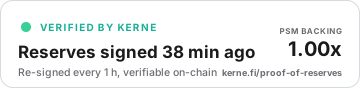
Yours renders the same way on your own site, pointed at your feed: one image tag, verified state only when the signature checks and the read is fresh.
What this is not, stated first
This kit is not GENIUS compliance, and buying it does not make you compliant with anything. The Act's monthly certification runs through registered public accounting firms and your regulator; it is an examination, performed by people licensed to perform it, and nothing we sell replaces or substitutes for it. The gap report is a technical recomputation of your token against the Act's published criteria and public on-chain data, not a legal opinion on your status and not a determination that you are or are not compliant. If a vendor tells you a software subscription or a report satisfies a statutory attestation requirement, they are selling you a problem.
What this kit is: the layer above the floor. The statutory examination happens monthly, in private, and your holders see a certification. The kit gives them the thing no examination provides: reads of your disclosed reserve addresses they can verify themselves, on a schedule, signed so the reads cannot be edited after the fact, and a public page that is honest about which part of your backing is checkable on-chain and which part rests on your attestor. Issuers that clear the floor and publish a verifiable layer above it will read differently from issuers that clear the floor and stop. See where the major dollar tokens stand today in the GENIUS compliance tracker.
What this is, stated plainly
This is attestation and objective-data tooling. The feed signs what the public chain shows for the reserve addresses you disclose, as of specific blocks. The verify page maps your trust boundary from your own published materials and live chain reads. The badge renders the freshness and authenticity of your latest signed read. None of it is a solvency opinion, an audit, a rating, or advice, and none of it asserts anything about reserves that do not live at the addresses you disclose.
We read public on-chain data only. If part of your backing is off-chain, your verify page says so rather than hiding it, because the honesty is what makes the checkable part credible. A signed read of a disclosed address proves what that address held at a block; it does not prove the address is all there is. Kerne runs this exact stack over its own reserves, with the same limits stated in the same words, at kerne.fi/transparency.
Setup, then a monthly watch
Our guarantee. If any read we sign and host for you does not cryptographically verify against the named signing key, we refund that month or re-run it, your call. That is the one promise attestation can make and keep. It is not a promise about your figures, about your solvency, or about any regulatory outcome; a faithful read of a short reserve will faithfully show the shortfall. Setup is live within 5 business days of receiving your token address and disclosed reserve addresses, or the setup fee comes back.
The setup fee is $999, one time, and includes your first month. That is the post-audit price: this page promised the earlier $499 rate would stand only until our own Hexens audit report was published, and that report went public in full on July 31, 2026. Pay in USDC on Base straight to the founder-controlled Kerne treasury address; the on-chain transaction is your receipt. As soon as it confirms, email your token address, chain, and disclosed reserve addresses to kerne.systems@protonmail.com. After the first month it is $99 a month on the same rail, invoiced monthly, cancel any month.
Pay the $999 setup in USDC on Base, then tell us your token and disclosed reserve addresses. Connect a wallet to pay in one click, or pay manually from any wallet or exchange and paste the transaction hash.
Buying for a company and need paperwork? Request an invoice with a reference number and payment instructions. No wallet needed to ask.
After you pay, send your details to kerne.systems@protonmail.com (or just reply to the receipt email). Token, chain, reserve addresses; we take it from there.
Rather email, or have a question about setup first?
The $999 setup is self-serve above. If you would rather not pay by wallet, or you want to confirm the kit fits your token before you pay, leave your email and your token. We reply from kerne.systems@protonmail.com. If you need to pay by invoice or bank wire instead of on-chain, say so here and we will send instructions.
Pieces, if you want them separately
The kit is the bundle. Each capability also exists on its own, priced on its own page.
A one-time signed statement of your reserves, when you need the artifact without the standing service.
The standing watch alone: alerts on your peg, pool, and reserves, without the public-facing pages.
The analysis of anyone's reserves, including your own before your holders read it elsewhere.
Kerne is infrastructure and a service provider, not an auditor, a rating agency, a registered public accounting firm, a custodian, or an investment adviser. The GENIUS gap report is a technical recomputation of a named token against the Act's published statutory criteria and public on-chain data at the addresses the customer discloses, and the readiness kit is attestation and objective-data tooling over the same public data. Neither is the examination or certification any statute or regulator requires, neither makes any issuer compliant with the GENIUS Act or any other law, and neither is an audit, a solvency or credit opinion, a recommendation, or any form of investment, legal, tax, or accounting advice. Kerne is early: it has one completed external audit, published in full on July 31, 2026, and its deployed vault runs earlier bytecode than the reviewed commit, disclosed at kerne.fi/dataroom; this tooling stands on cryptography and public data anyone verifies independently, not on our posture. The setup fee is $999 fixed including the first month, then $99 a month, earned on delivery. The earlier $499 setup price stood until Kerne's Hexens audit report was published; that report has been public since July 31, 2026, so new commissions are $999. A founding-customer offer ($299, first 3 issuers) ran through July 18, 2026 and has expired.